
Through the IPO, Burger King has raised Rs 450 crore, which will be used to rollout new outlets and retire debt.
While HDFC Bank has vowed to recoup its lost market share in the credit card segment in three to four quarters by aggressively sourcing new cards, brokerages believe it is a little hard to come by, given how competitive the landscape has become, with other players in the market becoming equally aggressive to gain market share. Kotak Institutional Equities in its report on Monday said, "We would like to believe that the recovery in market share is likely to be gradual, if any. "All the key players, including Axis Bank, are now willing to expand their credit card portfolios as they have tested quite well against Covid-19."


Retail inflation hit an eight-month high of 6.07 per cent in February, remaining above the RBI's comfort level for the second month in a row, while wholesale price-based inflation soared to 13.11 per cent on account of hardening of crude oil and non-food item prices, government data showed on Monday. The previous high for retail inflation was 6.26 per cent in June 2021. The consumer price index (CPI) based retail inflation, which is taken into account by the Reserve Bank of India (RBI) while deciding its monetary policy, rose mainly because of costlier food items, as per the data released by the National Statistical Office (NSO).
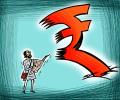
The rupee appreciated 7 paise to 79.74 against the US dollar in early trade on Thursday as a positive trend in domestic equities supported the local unit. However, a strong American currency overseas and forex outflows restricted the rupee's gain, dealers said. At the interbank foreign exchange, the rupee opened at 79.72 against the American dollar, then went lower to trade at 79.74 against the greenback in early deals, registering a gain of 7 paise over the last close.

Commercial banks in the country continued with their improving asset quality trend in the October-December 2021 quarter with slippages remaining under control coupled with healthy recoveries and upgradation of asset classification. The 28-listed banks reported improvement in bottom line with net profits rising 64.1 per cent year-on-year (YoY) and 21.5 per cent sequentially. This is mostly on account of a fall in provisions and contingencies.

More than 90 per cent stocks in the NSE 500 universe are currently trading above their 200-day moving average (DMA). Experts say this is a sign that the market has become overheated and can lead to a correction or sideways movement for a long period. The 200-DMA is a key technical indicator used by traders to get a sense of market direction. A level, which is roughly a 40-week average, often acts as key support or resistance.

Top companies in China are valued at 7.7 times the trailing 12-month earnings against a P/E ratio of 18.6 times for Nifty 50 companies.

The buyback price is at around 28 per cent premium to the current market price of Rs 67 on the Bombay Stock Exchange

Equity investors grew richer by Rs 32.49 lakh crore in 2020 on the back of smart returns in the stock market which had a roller-coaster ride during the year hit by the coronavirus pandemic. The COVID-19 outbreak ravaged lives and livelihoods on a global scale, shuttering businesses and jolting world equities. But amid all the gloom, Indian stock indices gave hope of returning to winning ways towards the latter part of the year.

India's rupee is likely to remain under pressure due to high prices of crude oil and other commodities, and may stabilise at around 79-80 against the US dollar in the near term, say experts amid limited headroom available with the Reserve Bank to check the weakening of the domestic currency. The currency has slumped over 5 per cent this year after Russia's invasion of Ukraine sent international crude oil prices soaring to a decade high. On Monday, rupee ended at a fresh all-time low of 78.34 (provisional) against the US dollar.
The combined profit before tax of 748 companies, which have declared their results for Q1FY21, is down 46 per cent YoY. Their net sales went down by a quarter as the Covid-19 lockdown led to a sharp fall in economic activity.

Gold prices are likely to decline further to around Rs 24,500 per 10 grams by December if the rupee continues to rule at the current level.

Analysts said the demand recovery in two-wheeler and car segments was skewed towards the semi-urban and rural markets.

Market players said a big upmove by the market will depend on policy action by the government to revive economic growth and corporate earnings revival.

Companies in the small-cap universe are having a dream run - the Nifty Smallcap 100 index has shot up more than 25 per cent on a year-to-date basis, even as the benchmark Nifty is up 7 per cent. This is the best start for the index since 2017 when the Nifty Smallcap 100 index surged 32.3 per cent between January 1 and May 10. However, in terms of outperformance to the Nifty, this year's performance is the best in more than a decade. A combination of sectoral tailwinds and lack of institutional selling pressure has helped small companies escape from the correction triggered by the second wave of Covid-19.

Campus recruits can also aim to double the existing entry level package by proving their skills through the TCS national qualifier tests.

The test - called the Truenat Beta CoV test - effectively enables same-day testing, reporting, and patient isolation initiation.
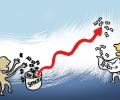
Small stocks made a dashing comeback in 2020 after delivering negative returns in the last two years as increased retail investor participation in pandemic times saw small-cap index surging up to 31 per cent and outperforming the bigger benchmark gauge. This year turned out to be eventful for the equity market, witnessing bearish and bullish sentiments at different points of time. While the initial part of COVID-ravaged 2020 saw the bears in full force amid concerns related to the pandemic and lockdowns hurting economic activities, bulls made a comeback towards the latter half of the year. As the market swayed with many lows as well as highs, small and mid-cap indices emerged as markets favourites in 2020.

The share of public sector undertakings (PSUs) in the total market capitalisation of listed companies--at an all-time low of 10 per cent currently --- may get a leg-up from the government's divestment push. Recently the government announced the successful sale of national carrier Air India to Tata Sons, India's first privatisation of a PSU since 2002-03. The transaction is expected to be completed by December.

While the market may remain volatile this year, analysts expect equities to deliver positive returns by outperforming inflation and government bonds, supported by the fiscal stimulus in the US.

The government is expected to dole out some populist policies, especially for the rural / farm sector while presenting the interim budget, given that the country is heading towards general elections over the next few months.

According to experts, the Nifty has continued to form lower top-lower bottom formations, a trend seen in the last five weeks, and witnessed sharp selling towards 9,700 zones.

While some companies, such as HSBC, have closed retail operations, big players such as India Infoline is scaling down.

Gold, which was hovering around $1,321 an ounce in January 2019, has already breached $1,600 per ounce in the past few sessions to a seven-year high.

Since last month, the realty (down 23%), auto (down 16%) and finance (down 14%) indices have underperformed the market by falling over 13%, as against 8% decline in the benchmark indices

Technically, the Indian economy is on road to recovery.

In the past two months alone, four companies have garnered a cumulative Rs 22,400 crore via this route.

Many investors want to exit equities now and re-enter when they begin to rise. Such timing is difficult to pull off.

Active subscriber base declined by 2.2 million on a month-on-month (MoM) basis to 970.2 million in August 2019, on the back of Bharti Airtel and Vodafone Idea losing customers. Jio was the only operator to add 7.2 million active subscribers in the same month.

Titan accounted for 59.6 per cent of his disclosed portfolio at Rs 8,355 crore. This is more than 10 times the next biggest holding, Federal Bank, at Rs 619 crore.

Over the past one-and-half years, the number of stocks trading below their respective face value has increased 29 per cent after a sharp correction in stocks of small-cap companies.

Stick to export-focussed plays, large-caps, say analysts

'Indians are great savers, but they are lousy investors.'

Overall, the domestic FMCG market bounced back to levels of 98 in June compared with 75 in May and 101 in March before the nationwide lockdown was announced. The pre-Covid March index for foods was 103, and for non-foods, it was 99.

Market sentiment around the stock has continued to be positive on the back of improving outlook for the US economy and anticipated weakness in the rupee.

To be able to tide over the current crisis, automobile manufacturers have waged a war against all cost heads.

The elections held in April-May 2019 will be an important determinant of future growth and investment.

Auto, pharma, IT, chemicals among sectors with significant reliance on UK and European nations with Tata Motors, Motherson Sumi, Tata Steel, TCS, Wipro, Infosys and Tech M among key names.

Equity mutual funds attracted an all-time high net inflow of Rs 28,463 crore in March, on continued interest by retail and HNI investors, who used market correction as a good buying opportunity.
